
The American League of Bicyclists recognizes May as National Bike Month. Since 1956 Bike Month encourages biking as fun, safe, reliable and sustainable way of travel for all skill levels. While our department works year-round to enhance cyclists’ safety, Bike Month provides a unique opportunity to highlight recent bicycle improvement projects across the city. This article also highlights the updated Bike + Walk Plan and explains how the proposed upgrades are designed and implemented to help all roadway users travel farther with confidence.
Bike + Walk Plan Update:
The Durham Bike + Walk Plan is a key project for the City and County, with the primary goal of creating low-stress networks that enable residents to use biking, walking, or rolling as viable modes of transportation for daily activities. This plan began in 2017 and, over the last two years, has undergone significant updates to support Durham’s rapid growth and continued commitment to improving walkability and cyclist safety. The updated version now includes Durham County, aiming to include rural and unincorporated areas in the network.
The Bike + Walk Plan consists of 75 high-priority projects, including infrastructure and safety improvements to be implemented over the next decade.
Projects include:
25 Corridor Improvements, including bike lanes, filling sidewalk gaps.
25 Intersection Improvements: installing high-visibility crosswalks, pedestrian signals, and islands across long stretches of crosswalks.
25 Micro-Gap Connections provide connections between missing points under 1,000 feet, connecting people to bus stops, trails, and sidewalks within neighborhoods.
Why This Matters:
The Bike + Walk Plan is more than a list of projects. It is the City and County’s commitment to remove barriers for all road users, enhance safety, and promote healthier and sustainable ways to travel. The plan will be presented to the Durham City Council next month for adoption.
Biking Improvements from 2025-2026:
Our Department is intentional about transforming our existing roadways into multi-use paths for all road users to enjoy themselves and feel safe biking, walking, or rolling. Over the last months and all of 2025, the Environmental and Street Services Department (ESS) repaved multiple roadways in Durham. Resurfacing provides our Department with the opportunity to work with the design team to conduct field investigations and traffic analysis, develop design plans, and hold engagement meetings with staff and stakeholders for the State-owned & maintained roadways. The resurfacing projects used community feedback and data to make existing roads in Durham more accessible to all road users, not just cars. However, due to existing roadways, our crews’ improvements are limited. We can add crosswalks and install protected bike lanes, but we cannot widen existing streets. Below are examples of tactics the City has successfully implemented across Durham to improve mobility for all road users on resurfaced roadways.
Our Tactics and Why We Implement Them:
Bike Buffers provide 1.5 to 3 feet of separation between cyclists and motor vehicles. This space helps reduce the risk of collisions, including incidents caused by opening car doors, and gives riders extra room to maneuver safely. In the City, these buffers are marked with reflective flexible posts, painted areas, or distinct lane markings to clearly define the space for all users.
Vertical Bike Lane Protection offers similar benefits and has been shown to reduce bike-vehicle crashes by up to 50%. Examples of vertical protection used throughout the City include bollards, planters, and curbs.
Both types of protection have been installed on this roadway and others across the City to improve cyclist visibility, create clearer separation between modes of travel, and reduce conflicts for everyone using Durham’s streets.
Contraflow Bike Lanes are designated lanes on one-way streets that allow cyclists to ride in the opposite direction of motor vehicle traffic. This design improves safety connectivity by reducing wrong-way riding and providing motorists with direct routes. These lanes are marked with double yellow lines, green paint, and signage to separate cyclists from motorists. The yellow lines or green paint are designed to increase visibility and identify potential conflict areas for all road users.
Bike Boxes are designated green-painted areas at intersections—typically located between the crosswalk and the motor vehicle stop line—or within bike lanes on high-traffic roads. These spaces improve cyclist visibility and help prevent “right hook” collisions, which occur when a vehicle turns into a cyclist’s path.
At red lights, cyclists position themselves within the green box while vehicles stop behind them. This design keeps cyclists visible in front of traffic, allowing them to proceed ahead of vehicles when the light changes or to merge safely before traffic begins moving.
Where to Find These Improvements:
Meriweather St (Old Oxford to Carver) February 2026
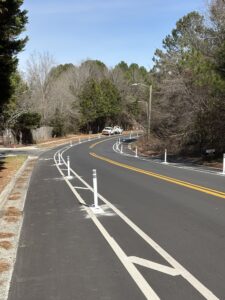
The City installed bike lanes and bike buffers along this roadway.
Liberty Street (Dillard to Roxboro) August 2025
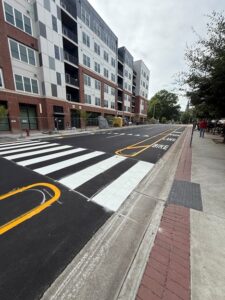
Contraflow bike lanes and buffers were added to this road to enhance cyclist safety.
Main St (Buchanan to Ninth) June 2025
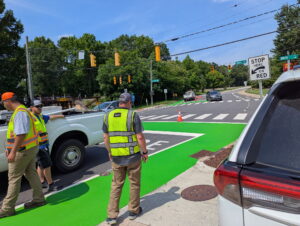
Bike boxes and continuous buffers were added to this roadway by our Department.
Additional Work:
Oak Grove Parkway January 2025
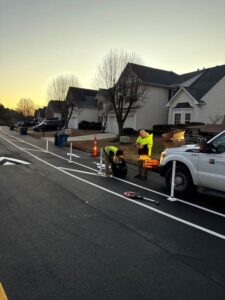
Improvements include bike lanes, buffer zones in some sections, traffic calming, and vertical protection in high-risk areas along this roadway.
Why We Made These Improvements:
The Transportation Department received funding for capital improvement projects (CIPs) to evaluate City and State roads scheduled for resurfacing. As mentioned above, resurfacing provides our department with unique opportunities to incorporate safety improvements such as bike lanes and crosswalks. Making the changes during resurfacing is cost-effective and efficient in delivering improvements to the City’s existing bike infrastructure.
The work on Meriwether Dr and Liberty Street was completed as part of the federal CMAQ (Congestion Mitigation and Air Quality) grant funding. This project provided the City with the opportunity to install 7.5 miles of bike lanes in Durham.
These safety improvements are intentionally designed to give cyclists the space they need to travel safely. However, their effectiveness depends on all roadway users understanding and following their roles to ensure a safe and successful experience for everyone.
Remember to start your bike month on the right pedal, “Do the R.I.D.E. thing.”
R- Respect the safety equipment
I- Identify where cyclists are on the roadway
D- Determine your distance to create a safe space for all roadway users
E- Exude caution in crossover areas
Happy Bike Month!